"Just hire a freelancer, it's cheaper" is common startup advice — but it's only true in some situations, and the real cost comparison is more nuanced than most founders realize. Here's an honest, numbers-based breakdown to help you budget correctly.
For the full picture on hiring freelancers in India, see our complete guide on hiring freelancers in India.
The Obvious Costs: Salary vs Project Rate
Full-time developer (India, mid-level): Typically ₹6-15 LPA (₹50,000-₹1,25,000/month) depending on city, stack, and experience — before additional costs.
Freelance developer (India, project-based): Typically ₹20,000-₹1,00,000+/month depending on complexity, or ₹500-₹2,000/hour for hourly engagements.
On the surface, freelance often looks cheaper per month. But this comparison alone misses most of the real cost picture.
The Hidden Costs of Full-Time Hiring
A full-time employee's real cost is significantly more than their salary:
- PF, gratuity, and statutory benefits: typically adds 12-15% on top of salary
- Health insurance and other benefits: varies, but commonly ₹5,000-₹15,000/month per employee
- Recruitment cost: agency fees or time spent hiring, often equivalent to 1-2 months' salary
- Office/equipment overhead: laptop, workspace, software licenses
- Onboarding and ramp-up time: typically 4-8 weeks before a new hire is fully productive, during which you're paying full salary for partial output
- Notice period and severance risk: cost if the role doesn't work out
Adding these, a full-time developer's true monthly cost is often 30-50% higher than their stated salary.
The Hidden Costs of Freelance Hiring
Freelance isn't free of hidden costs either:
- Management overhead: you (or someone on your team) needs to manage the freelancer's output, which takes real time
- Onboarding repeats each time: if you switch freelancers between projects, you re-explain context every time — unlike a full-time employee who retains institutional knowledge
- Availability risk: a freelancer juggling multiple clients may not be available exactly when you need them
- Quality variance: without a structured vetting process, freelancer quality can be inconsistent between projects
Real Comparison: A 6-Month Project
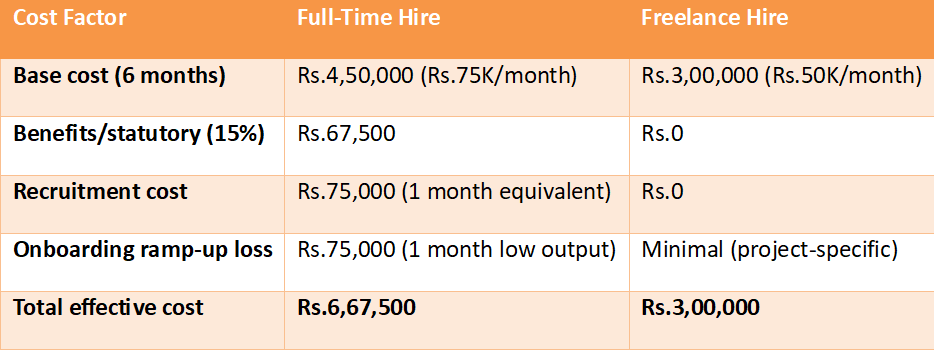
For a defined, project-based need over a limited timeframe, freelance hiring is often genuinely cheaper — not just on paper, but after accounting for hidden costs too.
When Full-Time Actually Makes More Sense
The math flips when:
- You have continuous, ongoing development work (not a defined project with an end date)
- Institutional knowledge and long-term product ownership matter more than short-term cost
- You need someone available on your schedule, not juggling other clients
- The role involves sensitive, ongoing access to core systems where continuity and accountability matter more
How to Reduce Freelance Hiring Risk
The biggest freelance-specific risk — inconsistent quality and availability — is manageable by hiring through a platform with verification and structured payment protection, rather than hiring informally.
On Legal Lancer, developers are identity-verified before listing (see our complete guide to hiring a web developer in India), and payments are held in escrow — released only when you approve completed milestones. This reduces the "hidden cost" of freelance hiring (quality risk) without adding the hidden costs of full-time hiring.
Frequently Asked Questions
Is it always cheaper to hire a freelancer than a full-time employee?
Not always — for short, defined projects, freelance is usually cheaper even after hidden costs. For ongoing, continuous work, full-time hiring can be more cost-effective over time due to lower per-hour rates and retained knowledge.
What's the biggest hidden cost businesses miss with full-time hiring?
Onboarding ramp-up time is often underestimated — a new hire typically isn't fully productive for 4-8 weeks, during which you're paying full salary for partial output.
How do I calculate the true cost of a full-time developer in India?
Add roughly 30-50% on top of the stated salary to account for statutory benefits, recruitment costs, and onboarding ramp-up time.
Can I hire a freelancer for ongoing, long-term work?
Yes, though at that point it's worth comparing the freelancer's ongoing rate against a full-time hire's total cost — long-term freelance retainers don't always stay cheaper than full-time once management overhead is factored in.
Ready to hire a verified freelance developer with protected payments? Browse Talent on Legal Lancer and post your project today.